The Impacts on Biodiversity of Synthetic Biology
The global conservation community stays abreast of cutting edge societal and scientific advances in synthetic biology in order to develop a position that optimises potential gains while minimising negative outcomes for nature and society.
Better conversations about synthetic biology
How can different sectors have better-informed, cross-sectoral conversations to help deal with the rapid development of technologies that intersect with nature and people? Synthetic biology is one such rapidly-developing technology, where fear of the unknown can cause paralysis. This intersection of technology and emotions requires thoughtful and informed conversations that generate new understanding to avoid overlooking powerful new options.
In 2016, the International Union for the Conservation of Nature (IUCN) approached the Luc Hoffmann Institute to seek expertise in convening and co-production. The IUCN wanted to apply this expertise to its task force and technical subgroup on synthetic biology and biodiversity conservation that was mandated by the 2016 World Conservation Congress in Hawaii. The task force were specifically examining the intersection of emerging synthetic biology technologies and their impact on biodiversity conservation in order to inform the 2020 global policy development process.
Synthetic biology is a complex and controversial field, with potentially large implications for biodiversity conservation, both positive and negative. This initiative was designed to increase understanding within the IUCN’s more than 1,300 member organisations of the potential range of impacts when synthetic biology interfaces with biodiversity and its conservation. It maps the different values, knowledge and positions related to synthetic biology to enable the conservation sector to play an informed role in the debate.
Programme timeline
2019
Acceleration
In the publication on ‘Genetic frontiers for conservation: An assessment of synthetic biology and biodiversity conservation’, the IUCN says “Many thanks… to the Luc Hoffmann Institute for accelerating this work”. As a result of our work IUCN is able to reframe the problem, develop a co-produced analysis, defend the scientific credibility of this analysis against detractors and successfully develop policy recommendations for the World Conservation Congress in 2020.
August 2019
Incubation
The global assessment comes under criticism from special interest groups. The IUCN releases a statement in which it is able to defend the global assessment thanks to the credibility, legitimacy and relevance of the collaborative design and the process used in forming it. The IUCN acknowledges the Luc Hoffmann Institute’s contribution to this successful design and process.
May 2019
Incubation
By integrating conservation stakeholders with those from the private sector and indigenous groups, the Luc Hoffmann Institute facilitates a new and more inclusive way of bringing together multiple kinds of evidence for difficult conservation issues. The Institute’s incubation and acceleration made it possible for IUCN to obtain funding of 200,000 CHF from the Swiss Government and to finalise the global assessment ‘Genetic Frontiers for Conservation’. This global assessment forms the basis of a resolution for consideration and adoption by the IUCN member states and organisations at the 2020 World Conservation Congress in Montpellier.
April-November 2018
Incubation
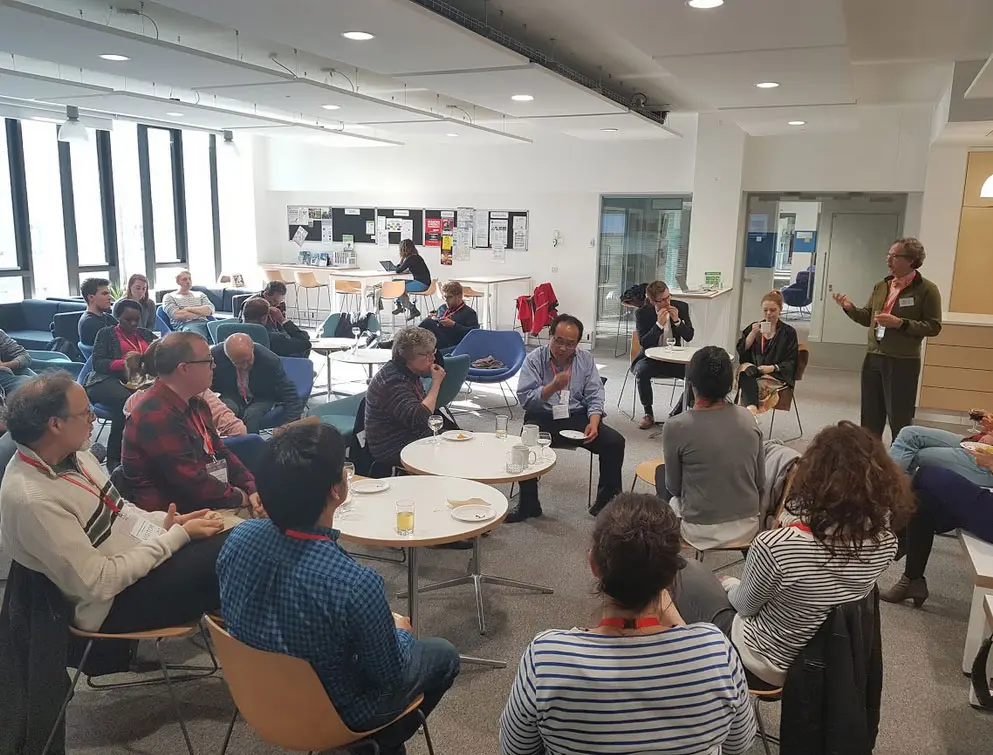
The institute designs and contributes to three IUCN writing workshops, including the Taskforce Inception Workshop pictured here, which generates new network connections and bridges different communities of practice.
February 2018
Incubation
The institute invests CHF 120,000 in seed funding and provides expertise for the design of the taskforce, framework design and creation, and to boost the diversity of participation by harnessing expertise from around the world. This stage included workshops in Cambridge for technical and steering work, an open public ‘listening’ forum as well as follow-up work held in Brazil.

2016
Incubation
The IUCN approaches the Luc Hoffmann Institute for guidance in convening and co-production for its task force and technical subgroup on synthetic biology and biodiversity conservation.