Exploring the topic of decolonising futures for nature
Collaborative Knowledge Building
- People
- Programme
- Themes
Introduction
Disrupting colonial legacies
The world is facing a planetary crisis shaped by ecological breakdown and entrenched colonial legacies (Adams and Mulligan, 2003). While conservation was once framed as the noble pursuit of protecting nature from humanity, today it is widely acknowledged that conservation itself has often been complicit in injustice, displacing Indigenous Peoples and local communities, erasing local knowledge systems and privileging technocratic solutions rooted in Western epistemologies (Kenrick et al., 2023). In efforts to protect nature, the sector has frequently replicated the same extractive logics it seeks to oppose (Cockerill and Hagerman, 2020).
As we look to the future, the stakes are not only biological but also ethical, cultural and epistemological (Doak et al., 2014). Conservation futures thinking – through foresight, scenario planning and strategic visioning – has emerged as a popular method to anticipate and shape long-term outcomes (Knight et al., 2019). However, much of this futures work remains embedded in colonial logics, linear temporalities and elite knowledge production (Sachs, 2021). As one participant in this inquiry noted, “futures are often imagined without us even when they are about our lands.”
Conservation, both as a discipline and a practice, is facing a paradigmatic challenge: How do we reimagine futures for nature in ways that are truly inclusive, just and plural? (Lanjouw, 2021). In agreement with Lanjouw (2021), the larger question is how to move beyond inclusion as an add-on, and toward deep epistemic shifts that centre relational worldviews, ancestral knowledges and more-than-human kinship. This requires resisting extractive approaches to knowledge integration, and instead fostering intergenerational sovereign collaborations with historically excluded communities.
These questions are critical to practitioners, policymakers, researchers and key stakeholders committed to transformational futures for nature. According to Todd (2016), ‘more-than-human kinship’ refers to the intricate relationships that exist between humans and other living things, including plants, animals, spirits and ecosystems, where these entities are acknowledged as active players in shared worlds that shape conservation.
This inquiry explores how Indigenous Peoples, particularly the Ogiek community in Kenya, understand time, kinship, and more-than-human relationships, and how these can inform decolonial futures for nature.
In so doing, the programme seeks to explore the possibility of collaborative knowledge building in futures thinking of conservation through the incorporation of non-Western approaches to the future of conservation.
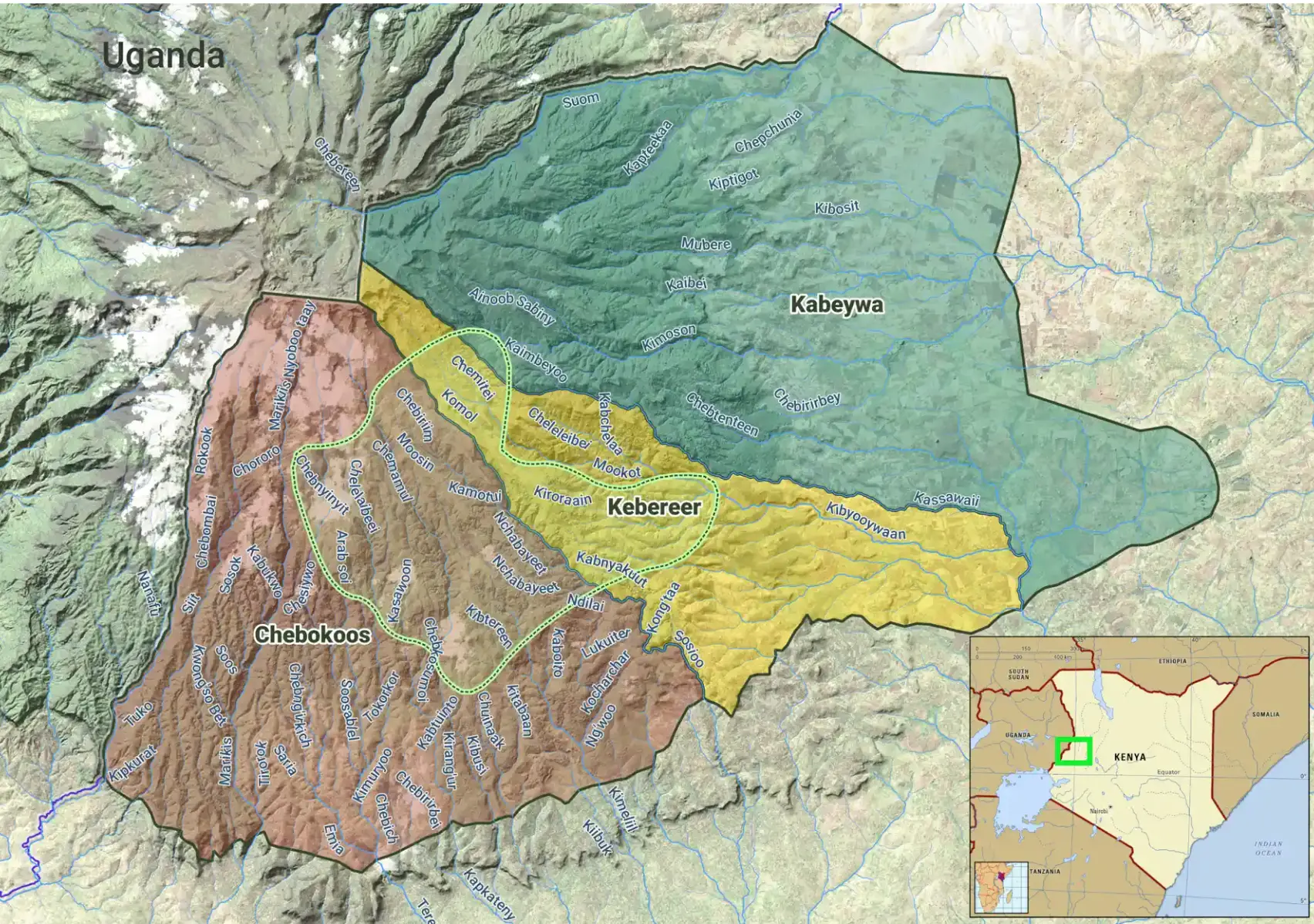
The Ogiek offer a grounded context for exploring Indigenous futures thinking in conservation, as they have historically faced dispossession through exclusionary conservation yet continue to assert their rights and ecological knowledge (CIPDP and MRG, 2016). By centring this case, the research aims to support situated, decolonial approaches that recognise Indigenous epistemologies as vital to reimagining plural and just conservation futures (African Court on Human and Peoples’ Rights, 2017). While many Indigenous Peoples around the world face similar challenges, I chose to focus on the Ogiek because, as a member of this community, I have built trust and strong relationships with elders, making access to knowledge and lived experiences more feasible. The Ogiek territory can be seen in figure 1 below.