Exploring the topic of decolonising futures for nature
Collaborative Knowledge Building
- People
- Programme
- Themes
Reimagining futures for nature
Finally, Ogiek futures are imagined through a lens that is inclusive of non-human elements. Planning is not limited to human stakeholders but extends to rivers, animals, spirits and plants. These Ogiek perspectives present a powerful challenge to dominant conservation models that prioritise so-called ‘expert-driven’, human-centric and short-term interventions (Nadasdy, 2003; Brockington and Igoe, 2006). For conservation leadership, particularly within international NGOs, government agencies and donor institutions, this demands a fundamental rethinking of what constitutes legitimate knowledge, who is included in planning and how decisions are made (Escobar, 2008).
Rather than treating Indigenous cosmologies and more-than-human relations as peripheral cultural heritage, conservation leaders must recognise them as valid governance systems that are embedded, adaptive and ethically robust (Kimmerer, 2013; Todd, 2016). This implies moving beyond externally imposed timelines and project cycles toward relational temporalities grounded in ecological rhythms and intergenerational stewardship (Whyte, 2018). Equally, it calls for a departure from tokenistic stakeholder consultations to participatory frameworks that include spiritual, ancestral and more-than-human beings in decision-making (TallBear, 2011; Celermajer et al., 2022). In practice, this might involve designing conservation plans through community storytelling gatherings (kirwokeet ), ceremonial consultations with elders and spiritual leaders or recognising culturally significant species (totemic beings) as legal entities with voice and agency. These shifts reposition Indigenous knowledge holders from information holders to co-governors and non-human kin as participants in shaping ethical futures for nature.
To meet the demands of plural ecological realities, planning frameworks must evolve to accommodate ontological pluralism and multispecies justice (Smith, 2021). This involves creating legal and policy mechanisms that legitimise Indigenous planning logics, develop context-responsive indicators of ecological health and reallocate power to frontline communities already practising reciprocal conservation (Tuck and Yang, 2012).
The Ogiek, in this regard, do not merely resist mainstream models; instead, they offer a relational and decolonial blueprint for reimagining conservation leadership. Their practices are rooted in kinship, ceremony and multispecies accountability, hence demonstrating the possibility of governance that is not only ecologically sound but also just. The approach challenges conservation leaders to shift from control to co-creation (Clare, 2018).
The Ogiek also resist imposed conservation timelines. They reject policies that treat land as extractive zones or projects with short-term goals. Instead, time is measured by natural rhythms, wet and dry seasons, food storage cycles and animal migrations. This aligns with Nadasdy’s (2003) analysis of Indigenous-state temporal clashes on visions of just ecological planning. Such scenarios include:
- Letting nature speak: Bee behaviour is read as consent or objection. For example, forcibly removing honey is seen as a violation that elicits ecological backlash.
- Centring more-than-human entities: Spirits of trees and rivers are acknowledged in planning ceremonies and rituals.
- Community-led forums: Structures like kirwokeet, youth mentorship and seasonal knowledge festivals were described as decision-making tools that include diverse voices, human and non-human.
“Who speaks for bees? They are violated when their honey is taken by force.” – Elder
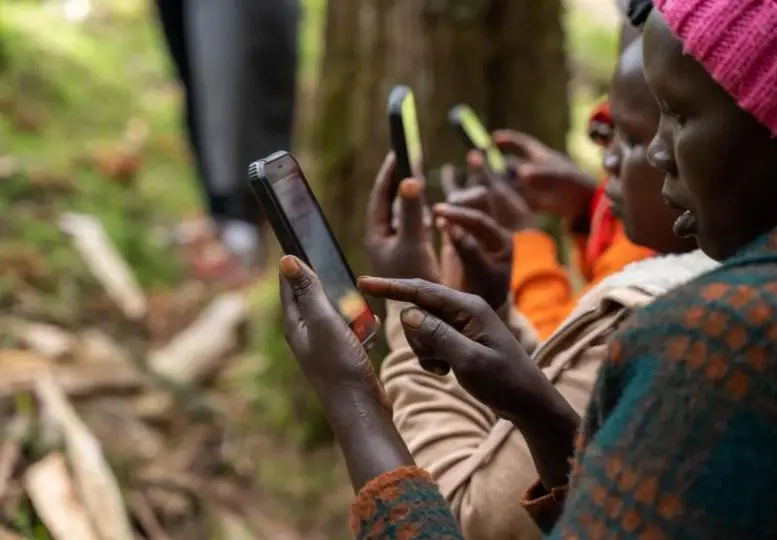
Communities have begun documenting good practices that integrate Indigenous and modern knowledge systems in conservation. These practices include mapping territories (see figure 5), community-led biodiversity monitoring, and documenting storytelling and customary bylaws to demonstrate Indigenous stewardship in planning for futures for nature and to build an interpretive system of environmental change. Elders and youth collaborate to create shared stories that preserve ecological meanings. This is a decolonial epistemology in practice: one that treats animals, seasons and spiritual forces as active participants in defining futures.
Participants critiqued top-down conservation models that treat the forest as ‘empty’ and erase Indigenous presence. They emphasised that Ogiek land-use practices, rotational harvesting, seasonal migration and sacred site protection are themselves conservation strategies.
One participant stated, “They come and say we destroy the forest, but we have lived with it for generations. We know how to care for it because we are part of it.” This aligns with Indigenous critiques of fortress conservation, which often displace communities in the name of environmental protection (Asher, 2021). Instead, the Ogiek envision futures grounded in autonomy, relational ethics and ecological balance. Their planning is not linear or technocratic, but relational and embedded. A youth participant imagined a future where “our children still gather honey, sing the same songs and walk the same paths with respect.” These expressions constitute a form of ‘decolonial futurity’ (Tuck and Yang, 2012), wherein Indigenous communities reclaim the right to imagine and enact futures that centre land, kinship and sovereignty.
“When a tree falls, monkeys cry. That means they lost a home.” – Youth participant